Compare cheap car hire in Greece with practical tips on airports, island driving, pickup locations and prices.

Greece is one of the easiest and most rewarding countries in Europe to explore by car. Whether you’re heading to the mainland or island-hopping, hiring a car gives you access to beaches, villages and scenic routes that are difficult to reach any other way.
On the mainland, distances can be significant, while on the islands, having your own car lets you escape busy resort areas and explore at your own pace.
Where You’ll Pick Up Your Car
Most visitors collect their rental car directly at the airport. In Greece, the setup is usually simple:
- Car hire desks are typically inside the arrivals hall
- Vehicles are collected from car parks just outside the terminal
- At smaller island airports, everything is within walking distance
Popular pickup locations include Athens Airport, Heraklion Airport and Corfu Airport.
Direct Flights from Ireland
Greece is well connected to Ireland, especially in the summer season.
- Dublin → Athens (seasonal)
- Dublin → Heraklion (Crete)
- Dublin → Corfu
- Dublin → Rhodes
- Dublin → Chania (Crete)
Flight times typically range from 3.5 to 4.5 hours depending on the destination.
Car Hire Companies in Greece
You’ll find both international and local providers across the country.
- Hertz
- Avis
- Budget
- Europcar
- Sixt
- Enterprise
Local companies are also common on the islands and can sometimes offer better value, though it’s important to check insurance coverage carefully.
Typical Car Hire Prices in Greece
| Season | Economy | Family Car | Larger Vehicle |
|---|---|---|---|
| January – March | €20 – €45 | €45 – €75 | €75 – €120 |
| April – June | €30 – €65 | €65 – €110 | €110 – €170 |
| July – August | €55 – €120 | €120 – €180 | €180 – €260 |
| September – October | €35 – €75 | €75 – €130 | €130 – €200 |
| November – December | €25 – €55 | €55 – €90 | €90 – €140 |
Choosing the Right Car
Your choice depends heavily on whether you’re on the mainland or an island.
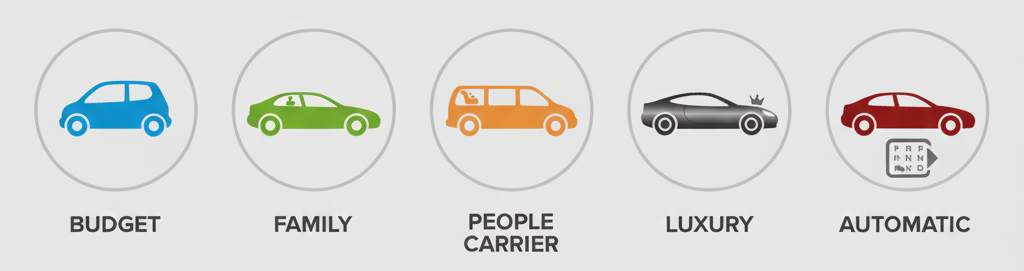
- Small cars – ideal for narrow streets and island driving
- Family cars – better for mainland road trips
- Estate cars – useful for luggage-heavy travel
- People carriers – suitable for groups and families
On many islands, smaller vehicles are easier to park and navigate.
Driving in Greece
Driving is on the right-hand side of the road. Roads vary from modern motorways to narrow rural routes.
Key things to know:
- Road signs use both Greek and Latin alphabets
- Driving standards can vary, especially in busy areas
- Motorways on the mainland may include tolls
Fuel stations are widely available, though less frequent in remote areas.

Mainland vs Island Driving
The experience can be quite different depending on where you are.
Mainland Greece:
- Longer distances between cities
- Modern motorways and toll roads
- Ideal for multi-day road trips
Greek Islands:
- Shorter distances but narrower roads
- More relaxed driving style
- Parking can be limited in busy resorts
Many travellers combine both by flying into Athens and then taking internal flights or ferries.
Where a Car is Most Useful
Car hire is particularly valuable in these parts of Greece:
- Crete – large island with long driving distances
- Peloponnese – mainland region with historic sites
- Corfu – mix of beaches and inland villages
- Rhodes – easy island road network
Even on smaller islands, a car allows you to reach quieter beaches and viewpoints.
Practical Tips Before You Book
- Book early for July and August travel
- Check insurance coverage carefully with local providers
- Consider airport pickup for convenience
- Choose a smaller car if staying on islands
Frequently Asked Questions
Do I need a car in Greece?
Yes, especially outside major cities or when visiting islands.
Is driving difficult in Greece?
It can vary, but most routes are straightforward once you are used to local driving styles.
Are automatic cars available?
Yes, though manual vehicles are more common.
Are there toll roads?
Yes, mainly on mainland motorways.
Can I rent a 7 Seater in Greece?
Yes, though availability may be limited on smaller islands.
Do I need a credit card?
Yes, most rental providers require one.
Is fuel expensive?
Fuel prices are generally similar to other European countries.
Are roads well maintained?
Main roads are good, but rural roads can be narrower.
Can I take a rental car on a ferry?
Some companies allow it, but you must check in advance.
Which side of the road do you drive on?
On the right-hand side.
Greek Food
When you visit Greece, make sure you sample plenty of Greek food from local shops and eating places. You will discover many local delicacies that you might have never ever heard of.
Take a long look at the the menu and ask the locals what they eat as this is a terrific approach to learn about new meals. Even the renowned Greek Salad is distinct in lots of locations in Greece and is also usually eaten every day.
A lot of people believe that wine was invented in Greece so it’s really worth sampling several of the neighborhood wines where they’ve got some of the greatest expertise on earth.
Nature in Greece
Even with its small size Greece has a quite varied terrain with splendid coastlines, rocky mountains plus lakes, rivers, gorges, forests and islands. This makes Greece a fantastic region for sports activities such as rafting, kayaking, hang gliding, bungee jumping and much more.
The marine parks in the vicinity of the islands Alonissos and Zakynthos make for an exciting stop in your tour. You will fall in love with the stunning Greek countryside. It is home to incredible floral life.
Summer Festivals in Greece
Greece holds a variety of events particularly throughout summertime. Open-air cinemas, carnivals and sports activities are all the rage.

The Athens Festival and the Epidaurus Festival are regarded as the most important art festivals in the country. Theaters like the National Theatre of Greece stage a range of plays. The Thessaloniki Film Festival is another great event.